
Agriculture stocks—are they worth your hard-earned money, or just a bunch of hay? The farming sector has been around forever, but it seems like people only talk about it when prices at the grocery store rise. Yet, there’s more to the story. Let’s dig into the pros, cons, and everything in between to see if these stocks are a good choice for investors like you.
What Are Agriculture Stocks, Anyway?
At their core, agriculture stocks represent shares of companies that either produce or distribute agricultural goods. Think everything from crop production (like corn or wheat) to equipment and technology (like John Deere, or Deere & Co.), to even food processing companies (like Tyson Foods). But are these stocks a reliable investment?
What Do the Numbers Say?
Here’s the deal. Agriculture stocks can be an attractive long-term investment, especially when you consider global population growth. The United Nations projects that the world’s population will hit 9.7 billion by 2050, which means more mouths to feed. In theory, this should drive demand for agricultural products.
But the truth is, they can also be volatile. Take a look at the following chart to see how agriculture stocks have performed recently.
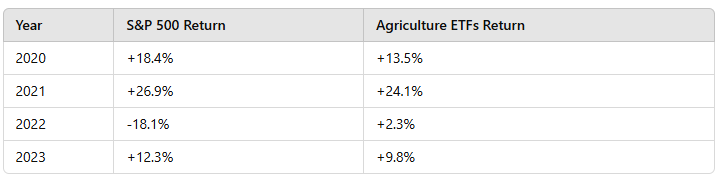
As you can see, agriculture ETFs (exchange-traded funds) have had their ups and downs. But compared to the S&P 500, they often offer a less dramatic ride. But what about the long-term?
Why Agriculture Stocks Might Be a Good Investment
- Global Demand for Food
More people means more food. Simple, right? Global food demand is expected to grow, and that’s good for ag-related companies. If you’re looking for stability, this could be a solid bet. In fact, Nutrien Ltd. (a fertilizer giant) and Archer Daniels Midland (ADM) are among the top players. Both saw steady growth even in challenging economic times. - Diversification for Your Portfolio
Adding agriculture stocks is a great way to diversify, especially since agriculture is often seen as a “defensive” sector. When stocks fall, food demand doesn’t exactly drop off. If you hold stocks like Corteva or Bunge Ltd., you get exposure to food production, logistics, and even tech-based farming solutions. These are more resilient against market volatility than the latest tech IPO. - Potential for Innovation
And here’s a juicy bit—agriculture isn’t just about plowing fields and planting seeds anymore. The sector is evolving rapidly with new technologies, like precision farming, bioengineering, and vertical farming. Companies like Deere & Co. are now investing heavily in AI and autonomous machinery. Investing in ag stocks today could be a way of getting in on the future of farming.
But… Agriculture Stocks Have Their Flaws
Despite the advantages, agriculture stocks are not foolproof. Remember, this is a sector deeply tied to weather, geopolitical tensions, and trade policies. In 2022, for example, the war in Ukraine sent wheat prices soaring, which disrupted global food supplies. That’s both a risk and an opportunity, depending on how you look at it.
Moreover, these stocks are often subject to heavy regulation. Prices of crops can fluctuate based on government policies, such as subsidies or import/export tariffs. While this can create opportunities for profit, it can also cause market instability.
Should You Buy Now?
Here’s a quick thought: If you’re someone who loves the idea of farming but can’t tell a plow from a tractor, maybe agriculture stocks are the way to go. But don’t expect smooth sailing. Like any investment, it’s a gamble—just with a bit more dirt on it.
Investing in agriculture may appeal to those who prefer tangible assets. You know, something that you can actually see growing. However, be prepared for the risks associated with weather patterns, government policy changes, and unpredictable commodity prices.
The Future of Agriculture Stocks
Are agriculture stocks a good investment in the long term? Experts think so—at least for now. Global trends suggest that demand for food, fuel, and fiber will continue to rise, and with it, agricultural companies could see growth. However, the sector is constantly changing, and with new challenges (like climate change and tech disruption), things might look very different in 10 or 20 years.
So, let’s get real for a minute. If you’re in it for the quick buck, this might not be your golden ticket. But if you’re looking for something more stable, diversified, and with a touch of sustainability, agriculture stocks might be your crop to harvest.
FAQs
Q1: Are agriculture stocks less risky than tech stocks?
A1: In general, yes. Agriculture is considered a defensive sector, which means it tends to be less volatile than high-growth tech stocks. However, external factors like weather events and government regulations can still cause fluctuations.
Q2: Can agriculture stocks help diversify my portfolio?
A2: Absolutely! Adding agriculture stocks like Corteva or Bunge Ltd. can provide exposure to essential global industries like food production and logistics. It helps reduce overall portfolio risk by introducing different market dynamics.
Q3: Should I invest in agriculture ETFs or individual stocks?
A3: Both options have their merits. If you want exposure to a broad range of agricultural companies without doing individual stock research, agriculture ETFs might be a good fit. But if you believe in the potential of specific companies like Deere & Co. or Archer Daniels Midland, individual stocks could be more rewarding.
External Links for More Info:
What do you think? Would you throw a few bucks into the soil of agricultural stocks, or is that just too much “dirt” for your liking? Leave your thoughts below!