
Farmers across India live on the edge, their livelihoods often hanging by the thinnest threads. One monsoon can ruin it all. Yet, amid the uncertainty, the National Agricultural Insurance Scheme (NAIS) stands as a lifeline, offering hope, stability, and security. Let’s explore how this scheme has impacted Indian agriculture — for better or worse.
What is the National Agricultural Insurance Scheme (NAIS)?
First, let’s get some clarity. The National Agricultural Insurance Scheme (NAIS) was introduced in 1999 by the Government of India under the Ministry of Agriculture. Its primary purpose? To offer farmers insurance coverage against the losses caused by unpredictable weather conditions, pests, and diseases. Think of it like a safety net for someone walking a tightrope, trying to balance the demands of nature and the market.
For example, imagine you’re a farmer in Tamil Nadu, planting your crops with hope in your heart. But then a sudden drought hits. Your crops wither, and you’re staring at a future of uncertainty. That’s where NAIS swoops in, providing compensation to ease the financial blow.
Objectives: Protecting the Unseen
The main objective of the scheme is to reduce the economic impact on farmers during times of natural calamities. But that’s not all; it also aims to provide affordable coverage, keeping farmers from bearing the brunt of nature’s fury.
Key objectives include:
- Providing financial support: Farmers can receive compensation based on the yield loss.
- Encouraging crop insurance: It’s not just about protection; it’s about creating awareness and educating farmers on the importance of insurance.
One might argue, “It’s just a drop in the ocean.” But for that one farmer in distress, it’s the difference between survival and loss.
Benefits: A Cushion in Times of Need
What do you get from NAIS? Let’s talk numbers.
- Crop Coverage: You can protect crops like paddy, maize, wheat, cotton, groundnut, etc.
- Risk Protection: Compensation is paid if there’s a loss of yield due to drought, floods, storms, or any other natural disaster.
- Affordable Premium: The premium rates are affordable—farmers pay a small percentage (2-5%) of the sum insured, with the government covering the rest.
- Financial Assistance: In case of a yield loss exceeding 50%, farmers are eligible for full compensation.
And then, of course, there’s the human side. For a struggling farmer, a payout could mean the difference between being able to replant crops or facing a season of desperation.
Eligibility: Who Can Participate?
Here’s the thing: Who’s eligible for this life-saving scheme? Well, it’s not as hard as you might think. All farmers who are growing notified crops in specified areas are eligible. This includes both owner cultivators and tenant farmers.
Let’s be real: if you own land, you’re covered. If you don’t, don’t worry. The scheme includes tenant farmers too, meaning you could be renting land but still get insurance coverage. It’s about inclusion, and for the most part, that’s the beauty of NAIS.
Farmers should:
- Be growing a crop covered by the scheme
- Register with the insurance company authorized by the government
- Pay the applicable premium
Application Process: How Do You Apply?
It’s pretty simple, honestly. But here’s where the real struggle begins for many farmers — paperwork. But hold on, let’s take it step-by-step:
- Visit the nearest branch: Farmers need to approach their local insurance office or participating bank.
- Fill the forms: Application forms need to be completed, detailing the crops and the land.
- Submit documents: For the system to work, you’ll need to provide some documents.
And here’s where farmers often trip up. They may not have access to all the required documents, or they’re living in remote areas with limited connectivity.
Documents Required for NAIS
- Proof of land ownership (Record of Rights or Pattas)
- Crop details (Type of crop and area under cultivation)
- Aadhaar card (for identification)
- Bank account details (for receiving compensation)
- Ration card (if applicable)
Now, imagine a small farmer in a village in Uttar Pradesh. Sifting through paperwork, figuring out what to submit—it’s a process that can make you want to scream. But once it’s done? It’s like a weight lifted off your shoulders.
Key Metrics and Statistics: The Numbers Game
Let’s dive into some metrics that show the real impact of the scheme:
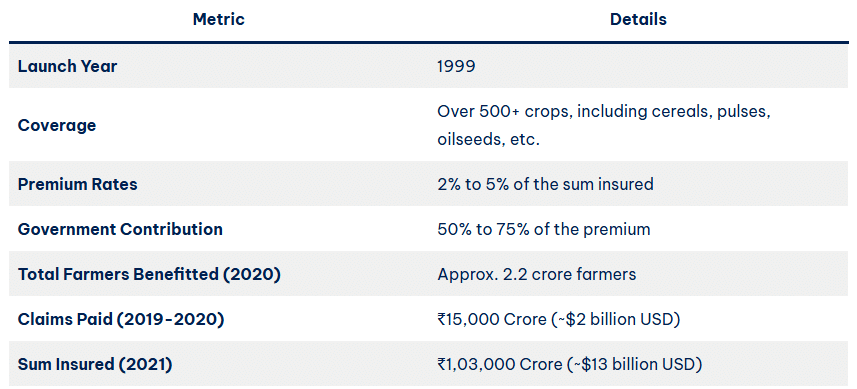
When you look at these numbers, it’s hard not to feel a sense of relief. A staggering ₹15,000 crore paid out to farmers in 2019-2020 isn’t just a statistic; it’s a lifeline. It’s the difference between a farmer having a home to return to after losing his crops and having to leave it behind.
Sources and References
For more information, the official sources can be found at:
- National Agricultural Insurance Scheme – Ministry of Agriculture
- Crop Insurance: Latest Updates & FAQs
- Press Release on NAIS Implementation
FAQs: Clearing the Air
Q: Can I insure my crop if I don’t own land? A: Yes, tenant farmers and sharecroppers can also avail of the insurance benefits.
Q: What if my crop suffers a loss, but I didn’t take insurance? A: Unfortunately, you won’t be eligible for a payout if you haven’t insured your crop under the NAIS.
Q: How is compensation calculated? A: Compensation depends on the extent of the yield loss. A standard formula is used to determine the loss based on the area and crop.
Q: What about natural disasters that are not covered by NAIS? A: If the disaster is not mentioned in the policy, compensation won’t be granted, though exceptions may apply based on policy revisions.
In Conclusion: A Blessing or a Bureaucratic Nightmare?
In the end, the National Agricultural Insurance Scheme represents a paradox. It’s a great initiative — it’s there for farmers, it’s covering risks that they can’t predict, and it’s helping the agricultural sector remain afloat despite the odds. But navigating the application process, document requirements, and bureaucratic hurdles? That’s a whole different story.
Farmers, especially in rural areas, often face barriers to accessing this insurance, whether due to lack of awareness, poor infrastructure, or technical glitches. But when it works, it’s beautiful. A safety net when life (and weather) throws you off balance.
Have you ever felt like everything is going wrong, only to find a small glimmer of hope in the form of a government scheme? That’s what NAIS tries to offer. A glimpse of security for people who often have no one else to turn to.